Flies
8.7 FLIES
Flies are harmful to the health of livestock for several reasons:
Flies irritate animals and prevent them from eating and resting.
When many flies bite an animal, it can become weak.
Flies carry infection to wounds and to the eyes.
Some flies lay eggs which hatch as maggots on the animal. The maggots feed on the flesh of the animal, causing extensive tissue damage.
Biting flies can spread blood-borne diseases, such as the tsetse fly which carries trypanosomiasis in Africa.
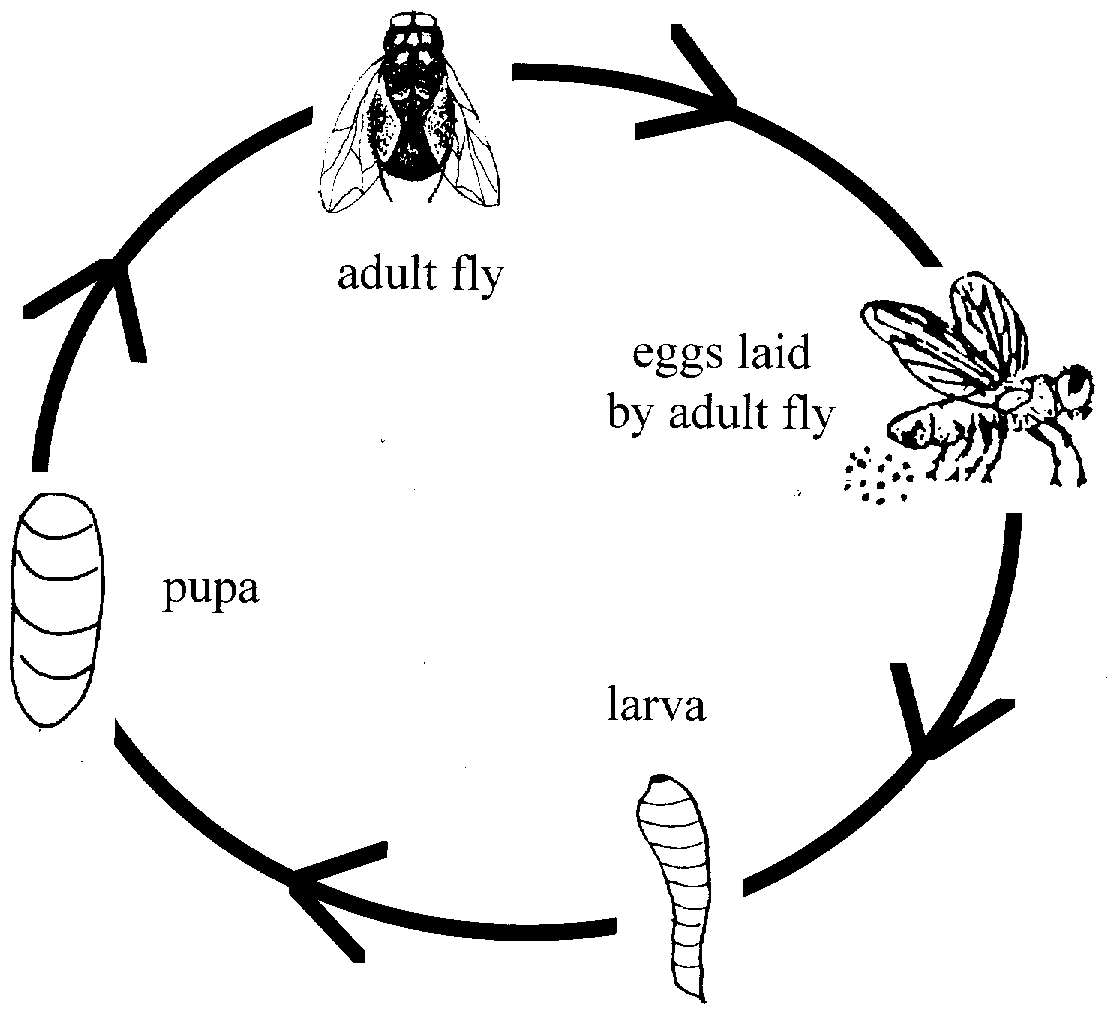
Life Cycle of Flies All flies go through a cycle where the adult female mates and then lays eggs. The eggs hatch and become larvae (sometimes called maggots). The larvae develop into pupae, and then adult flies. This whole life cycle can be as short as one week in some species, or it may be as long as one year.
Symptoms / Diagnosis: Adult flies themselves are easily seen. In addition, livestock bothered by adult flies often move nervously, and may run in groups as they try to escape the biting, buzzing, and irritation. For other flies, the larvae (maggots) are the form of the insect that cause animal health problems. Diagnosis of larvae infestation often requires close observation.
Treatment / Control: Flies are difficult to completely control. However different methods may help reduce the number of flies and the level of aggravation.
Eliminate the places where fly larvae may develop.
Spread manure thinly over the pasture so it dries out. Fly eggs cannot hatch and develop properly in dry manure.
Some ducks eat insects, and chickens eat ticks. Keeping ducks and chickens with animals like cattle helps to control flies and ticks.
Cover or remove rotting material, manure and compost where larvae develop.
As with medicines for tick control, insecticides for fly control must be used carefully. See page 108 and Chapter 26, Insecticide Appendix.
Direct Application: Insecticides may be directly applied to the animal through sprays, pour-ons, or ear tags that have the insecticide in them. Pyrethrins are often quite effective against flies.
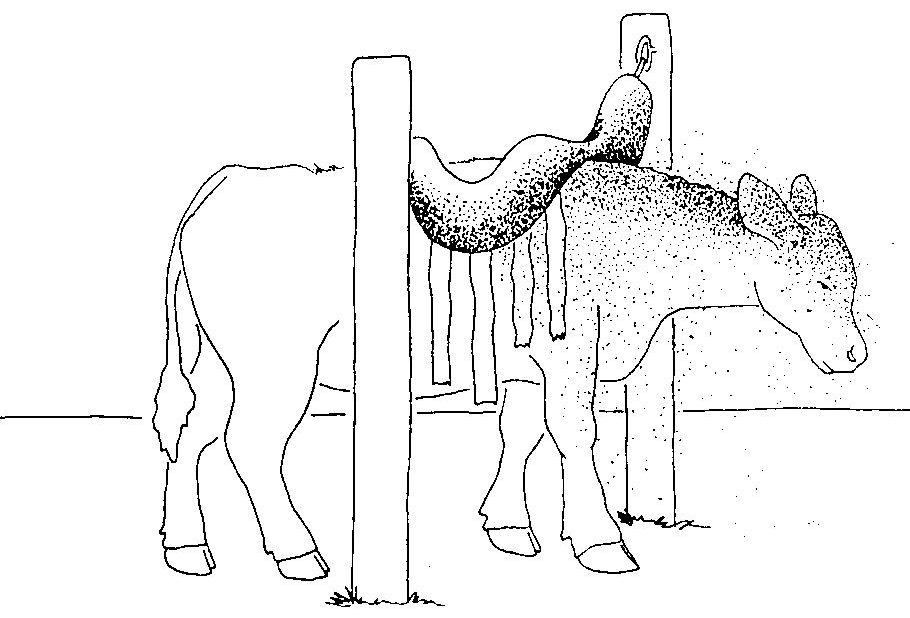
Self-applicators or back rubbers can be made from a sack containing insecticide dust, or soaked in insecticide oil. Coumaphos can be used in oil or as a powder. (Mix 300 ml of 11.6% EC in 4 liters of diesel fuel.)
Put the powder in a burlap sack, or soak the burlap sack in the oil mixture. Then tie the sack around a tree or post, or wrap it round a wire between two posts. Animals learn to rub against it to control their own flies. It may need replacing after several weeks.
Cow Walking Under Back Rubber That Has Insecticide On It