Teeth Problems
11.2.2 Teeth Problems Sometimes animals are not able to chew their food properly because of problems with their teeth. They can become very thin and sickly. The following four causes are among the most common:
1. The animal's upper and lower teeth may not be properly aligned to chew well.
| Cow with crooked mouth | Horse with normal teeth | Horse with underbite called “monkey mouth” | Horse with overbite called “parrot mouth” | Horse with overbite called “parrot mouth” |
Treatment of teeth that are not aligned properly: There is no treatment. The condition can be managed by feeding soft, high quality food. The animal should not be used for breeding because this condition may be passed on to future generations.
2. Painful, missing or infected teeth are more common in older animals, particularly on those which have been overgrazed on sandy soils. Teeth problems are also caused by calcium / phosphorus deficiencies, especially during the time of tooth development. In general, teeth problems can be reduced by providing mineral mixes and by preventing animals from overgrazing pastures.
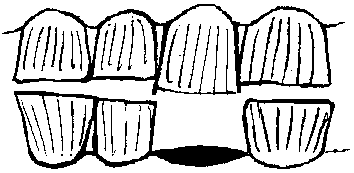
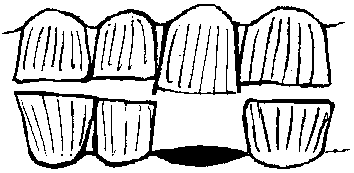
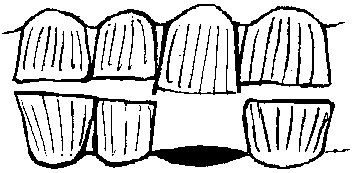
The animal's teeth may be worn down or missing (especially a problem in old animals, particularly those that have grazed on sandy soil).
Missing molar Symptoms: Difficulty eating or swallowing. Salivation.
Diagnosis: Check the teeth to see if one is rotten or broken, or if teeth are worn away.
Treatment for infected, painful teeth: It may be necessary to restrain the animal and remove the rotten tooth with a forceps or pliers. If the animal has a fever, give it antibiotic injections. Penicillin is usually effective. Feed soft food.
Removal of the infected teeth. This is often difficult unless the animal is anesthetized or properly casted and restrained (See pages 18, 21, 26, 27.)
Anesthetize or cast the animal and securely restrain it to avoid injury to itself and to you.
Hold the mouth open with a mouth speculum or block of wood. Be careful not to damage the tongue.
Grasp the affected tooth with a pair of pliers and wiggle it until it is loose enough to remove; then remove it.
Treatment of worn or missing teeth: There is no treatment. Old animals in this condition should be culled from a herd. The problem might also be managed with high quality feed and drinking water.
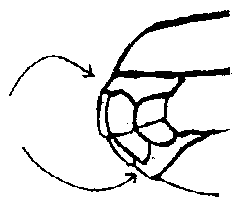
2. The animal's gums may be infected or rotten.
Treatment for infected, painful gums: If the animal has a fever, give it antibiotic injections. Penicillin is usually effective. Feed soft food.
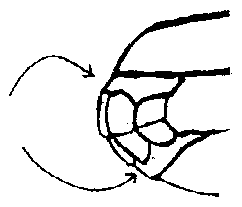
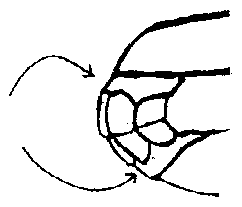
4. The special case of horses. The upper jaw of horses is wider than the lower jaw. This may cause the inner edge of the lower back teeth (molars) and the outer edge of the upper back teeth (molars) to become sharp.
Symptoms: The horse may have sores on its cheeks and tongue, and much food may drop out of its mouth when the animal eats. Horses with sharp teeth often become thin.
Diagnosis: Based on symptoms.
Treatment: File the outer edge of the upper molars and the inner edge of the lower molars with a file (called a “float”).
Upper and lower jaw showing Floating a horses teeth
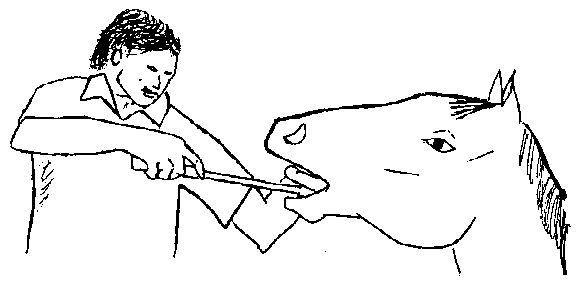
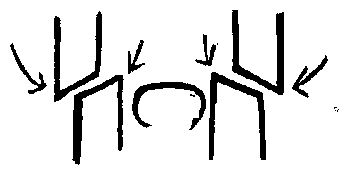
where the teeth become sharp (arrows)