Problems of the Mouth (Biting, Chewing and Swallowing Disorders)
11.2 Problems of the Mouth (Biting, Chewing and Swallowing Disorders)
The lips, the teeth, and the tongue, are all necessary for proper biting, chewing, and swallowing. If an animal has saliva dripping from its mouth, or if it takes food into its mouth but cannot chew and swallow it, examine its mouth very carefully.
Before examining the mouth of an animal, take a proper history to make sure that it does not have rabies! An animal with rabies may appear to be choking on something, or unable to swallow. See pages 52, 251, 253. If in doubt about rabies, always wear plastic gloves to protect against the saliva of the animal.
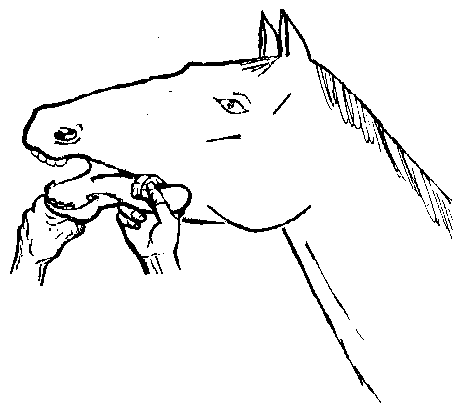
Examination of the Mouth of Livestock and Horses 46 After making sure that the animal does not have rabies, do the following:
1. Put the animal in a crate, or cast it.
2. Grasp the tongue firmly, gently pull it out of the mouth, and examine it. Look for sores and infections in the mouth.
3. Place the tongue to one side between the molar (rear) teeth to prevent the animal from gritting its teeth or accidentally biting you (usually an animal won’t bite its own tongue).
3. Carefully slide your hand over the top of the tongue and back to the throat. The hand should be kept in the middle of the mouth - as far away from the teeth as possible.
5. Feel carefully to determine if there is a sore in the throat, or if the animal has something caught in its throat.
General Treatment of Biting, Chewing and Swallowing Problems:
When an animal has a problem swallowing, or chewing, give it soft food. For example, give the animal a watery paste of cooked grain that does not require much chewing and can be easily swallowed.