Fungi (Ringworm)
8.9 FUNGI (RINGWORM) Note: The change to pitch (12) and font (1) must be converted manually.
Ringworm is a disease that affects the hair and skin. This disease is found all over the world. It is caused by a single-celled organism called a fungus. In particular, young animals kept in damp, dark conditions seem to suffer from it. When the animals are moved to a dry, clean, sunny place, the fungus infection often clears up on its own. People can also get ringworm, so technicians should also be careful when handling animals with ringworm.
Symptoms: Round shaped areas of hair loss develop mostly on the head and neck. These areas become dry and crusty, and turn a gray color. Sometimes the animal spends time scratching these spots.
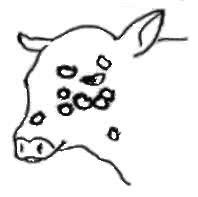
Diagnosis: Based on the observed symptoms. One can also remove some of the hairs and crust from the edge of the area of hair loss. Place these hairs on a microscope slide with dilute potassium hydroxide solution for examination. The hairs and crust can also be placed in a clean bottle and sent to a laboratory for fungus identification.
Treatment: The infection spreads easily from animal to animal. It may also spread from feed racks and water troughs where animals scratch themselves.
Treatments applied directly (locally) to infected areas include:
Tincture of Iodine every other day for seven to fourteen days. Don’t get this into eyes or on sensitive tissue.
Copper Sulfate powder mixed with petroleum jelly (Vaseline). Apply once and remove completely after 24 hours to avoid burning sensitive skin.
Thiabendazole paste: one or two applications several days apart.
Anti-fungal salves or creams that may be available in the market. (e.g. human preparations, Tinactin, etc.)
Systemic treatments include:
Sodium Iodide given IV or Fulvicin (griseofulvin) boluses Prevention / Control: Clean and dry pens, sunshine, and good diet, all help to prevent ringworm.