Ticks
8.3 TICKS
Tick can be seen attached to the animal's skin, or sometimes inside the ear flap, or around the udder, scrotum, tail, anus, and vulva.
Symptoms and Diagnosis / Lifecycle Direct Damage: Ticks directly damage an animal by sucking blood, causing:
reduced growth and/or weight anemia (thin blood) and weakness damage to hide or teats licking and scratching, instead of contented grazing sores or breaks in the skin that become infected or attract screw worm flies reduced fertility and/or milk production reduced immunity to other diseases paralysis Indirect Damage: Ticks also carry and infect animals with serious diseases such as anaplasmosis, Babesiosis, heartwater disease, and theileriosis. These are called "tick-borne diseases," since they are transmitted by ticks.
Life cycle of ticks
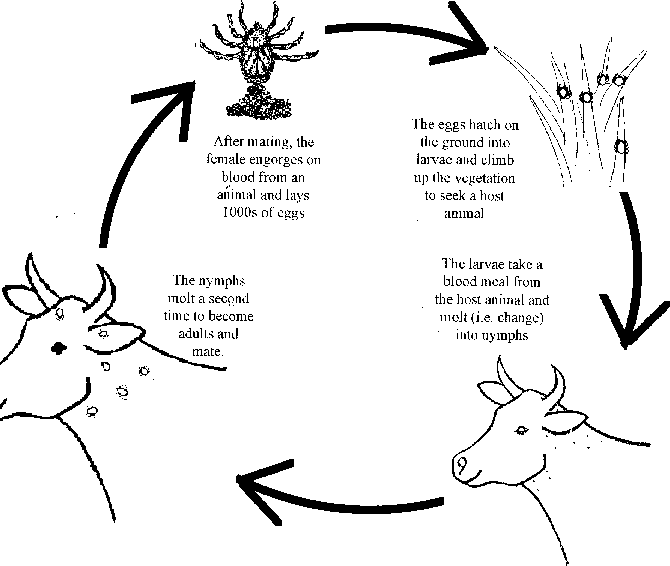
Ticks spend part of their lives on the ground, and part on the host-animal. The amount of time spent on the host-animal varies with the species of tick. The process when the tick matures from one stage to another stage is called a “molt.” In general, eggs are laid on the ground and hatch into six-legged larvae. After sucking blood from an animal, the larvae molt (mature) into eight-legged nymphs. The nymphs attach themselves to a host-animal, fill with blood, and drop off. On the ground they molt into adult ticks. The adult ticks crawl up on grass or bushes, attach to a passing host-animal, mate, and feed on blood. The female adult tick then drops off the host-animal, lays its eggs on the ground, and the cycle begins again. The entire cycle may take up to one, two, or three years, depending on the species of tick and the weather conditions.
Types of ticks Ticks are described as ‘hard-bodied’ or ‘soft-bodied,’ based on their body form. They are further described as ‘one-host,’ ‘two-host,’ or ‘three-host,’ based on the number of host-animal species they feed-on during their life cycle. A ‘one-host’ tick feeds on the same host-animal as a larva, a nymph and an adult. It drops off only to lay eggs. ‘Two-host’ and ‘three-host’ ticks change host-animals between stages of development.
Control measures against ticks vary, depending on the type of tick involved. Australia and Latin America have one-host ticks. Africa and North America have a mixture of one-host, two-host, and three-host ticks.
Natural or acquired resistance to ticks or tick-borne diseases Animals imported from an area without ticks, and European breeds, tend to be less resistant to ticks and tick-borne diseases. Some animals, such as the "zebu type" of cattle, are more naturally resistant to ticks and the diseases they cause. Animals that are born and raised in a tick-infested area are usually more resistant than imported animals. Even ‘resistant animals’ may lose their resistance if they have no exposure to ticks for long periods of time.
| Warning! Importing less resistant animals into tick infested areas can be disastrous. Many animals may become sick and/or heavily infested with ticks. Imported cattle usually require more intensive tick control measures than native cattle. |
Diagnosis: Finding the ticks on the animal provides a definitive diagnosis. However, a diagnosis can also be made by observing the symptoms and knowing that ticks are common in the area.
Treatment / Control and Prevention: Chemicals used to kill ticks are called "acaricides," "pesticides," or "ixodicides.” The following information is needed for good tick control:
What are the main types of ticks in the area? One-host, two-host, or three-host ticks?
Are tick-borne diseases killing or making many animals sick in your area?
What specific areas, seasons, and type of animals develop problems?
What acaricides are available, in what form, and at what cost?
Are the ticks in your area known to be resistant to certain acaricides?
These questions can usually be answered by an agricultural extension agent or agricultural college in your country.
| DANGER!!! (The following holds true for most pesticides - not just those used for ticks.) |
|---|
| All pesticides are poisonous if mixed improperly. |
| Pesticides must be stored safely away from children and animals. |
| Always read and carefully follow the instructions which should always be issued with the pesticide. Do not use pesticides which are unlabeled or have no instructions. If you are not sure how to mix them, seek advice from someone who knows how to use them - or do not use them. |
| Use pesticides only from reputable chemical companies. |
| Make sure antidote (or treatment) is available to treat accidental overdose of the pesticide you are using. Know how to use the antidote. Quick access to an antidote is important, particularly, if you are treating a large number of animals. |
| WARNING!! |
| Avoid splashing pesticides on your skin or in your eyes. |
| Wear rubber gloves when mixing or applying pesticides. |
| Avoid contaminating drinking water or feeds with pesticides. |
| Do not mix different pesticides together unless the manufacturer specifies that the chemicals may be mixed. |
For the details regarding these different methods, See Chapter 26, “Insecticide Use for Control of External Parasites.”
Controlling ticks through pasture management This method might work in Australia and parts of South America where only one-host ticks exist, and where there are few wild animals to maintain the tick population. Tick-infested areas should be fenced off, and no livestock allowed to enter for three to six months. During this time, the ticks die because they have no host-animals on which to feed. The amount of time required depends on the temperature and humidity. Hot, dry weather kills ticks more quickly (i.e. within three months), than cold, wet weather. Tick control through pasture management may fail in windy areas, since strong winds can carry tick larvae for considerable distances and re-infest pastures.
In areas where there are many wild animals, and where two-host and three-host ticks exist, good tick control through pasture management is not possible.
Ineffective methods of tick control FIRES: In some areas, fires are used in an effort to control ticks. This does not work well because the tick eggs and larvae buried in the soil are protected from the fire. This practice is also harmful to the environment as it burns the organic matter in the soil and the soil becomes less fertile.
PASTURE SPRAYING: Pasture spraying is largely ineffective and very expensive. It may also harm the environment by contaminating drinking water and killing useful insects.
| Controlling ticks by spraying or burning pastures is INEFFECTIVE and degrades the environment. |