Passing a Stomach Tube in Ruminants (to Give Fluids or to Relieve Bloat)
4.7.3 Passing a Stomach Tube in Ruminants (to Give Fluids or to Relieve Bloat)
To pass a stomach tube in ruminants, a long, flexible (rubber or plastic) tube and a short, hard pipe (called a "speculum") made of metal or bamboo are needed. Both the tube and the speculum should have smooth edges to avoid injuring the animal's mouth or throat. To prevent the animal from biting the tube, first gently insert the speculum into the animal's mouth and hold it firmly so that the animal does not swallow it! Pass the tube through the speculum until it touches the back of the throat and stimulates swallowing. As the animal swallows, gently push the tube down the animal’s throat and into its rumen. You can often observe the tube pass down the left side of the animal's neck.
Check to make sure the tube is not in the windpipe! If while passing the tube, the animal starts struggling and coughing, withdraw the tube and start again (the tube may have entered the wind pipe instead of the food pipe). In ruminants, once the tube is in the rumen, check to see if the smell of rumen gas comes out of the tube. If the animal is bloated, gas may rush out. It may be necessary to move and twist the stomach tube or press on the animal's side until the tube is in a pocket of gas. Before putting medicine down the tube, blow air down it and have someone listen on the left flank for gurgling sounds in the rumen (in ruminants). If there is any doubt about whether the tube is in the rumen, withdraw the tube, let the animal rest, and start again. When the tube is in the rumen, attach a funnel to the free end of the tube and pour the liquid medicine down the tube.
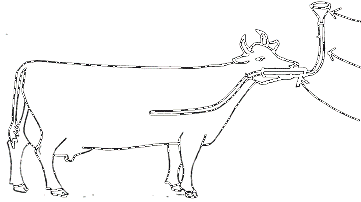
funnel tube speculum To remove the tube, first blow in the tube to empty it. Then, cover the end of the tube with your thumb and pull the tube out rapidly. Finally, remove the speculum.
Size of tubes and speculums: In cattle, the speculum should be about 25 centimeters in length and a diameter that comfortably fits in the mouth. The flexible tube should be approximately two meters in length and a diameter that can fit through the pipe. In sheep and goats, the hard tube should be about 12 centimeters in length and a diameter that fits comfortably in the mouth. The flexible tube should be at least one meter in length and a diameter that fits through the speculum.
Caution about passing stomach tubes in horses: In horses, the procedure is similar except a speculum is not needed and the tube is passed along the bottom surface of the nose (not the top surface, otherwise the nose will bleed!), down the throat and into the stomach. Be extremely careful in horses because it is much easier to accidentally pass the stomach tube down the wind pipe and into the lungs.