Liver Flukes (Fasciola)
27.6.1 Liver Flukes (Fasciola)
Liver flukes are a serious problem of livestock in many countries. The two most common liver flukes have the scientific names “Fasciola hepatica” and “Fasciola gigantica.” Flukes can be a problem wherever there exists a certain species of snails and wet conditions such as rice paddies. Even if animals are not grazed on rice paddies, they can be fed rice straw contaminated with liver fluke cysts called “metacercariae.” Liver flukes damage the liver tissue and can block the liver ducts.
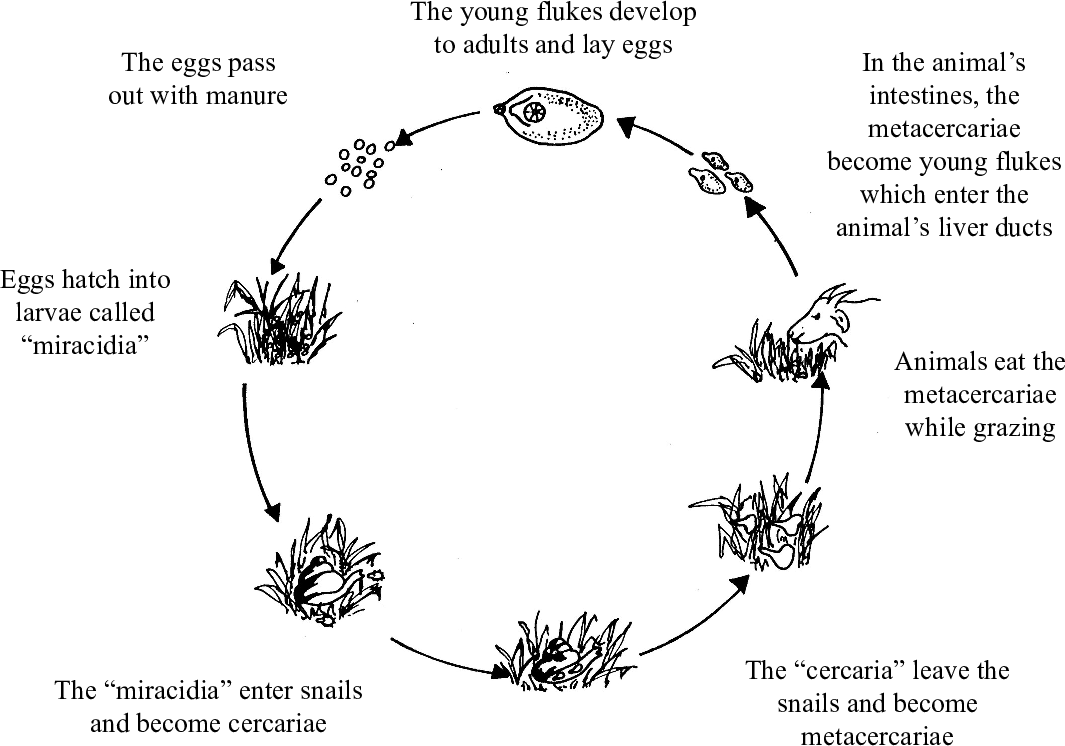
Life cycle of liver fluke 1. Adult liver flukes lay eggs in the bile ducts. The eggs pass into the small intestine and out of the animal with the manure.
1. In wet environments, the eggs hatch into larvae called “miracidia”
1. These larvae burrow into snails which are “intermediate hosts,” and develop into “cercariae” another stage of larvae.
1. The cercariae burrow out of the snail and onto blades of grass or straw. They make protective shell and become “metacercariae” which is about the size of a grain of dust.
1. Animals eat the metacercariae while grazing. In the intestines, the metacercariae lose their shell, become young flukes and travel to the liver where they become adults. The cycle usually takes about 2 months.
Symptoms of liver fluke:
The symptoms of liver fluke are loss of appetite, diarrhea, poor condition, and anemia. If the anemia is severe, fluid may collect under the lower jaw. A severe liver fluke infection damages the liver, which may result in “jaundice,” a condition which turns the tissue yellow, and is a sign that the animal may die. Symptoms often become more severe when food is scarce, for example, during the dry season.
Diagnosis of liver fluke:
Symptoms: Liver flukes can be diagnosed on the basis of general symptoms, knowledge that liver flukes are a problem in your area, and response to treatment.
Necropsy: In dead animals, liver flukes may be seen in the liver ducts. They are flat like a leaf and up to five centimeters in length. Liver flukes also damage the liver tissue, giving it a hard texture. Examining livers of dead animals is one of the best ways to verify whether liver flukes are a problem in your area.
Laboratory: Examining fecal specimens for liver fluke eggs is useful, however infected animals may have a negative result (i.e. no fluke eggs found).
Treatment of liver fluke:
There are several good medicines for liver flukes. Use the label to verify whether a certain medication is effective against liver flukes. Use that which is least expensive and known to be effective in your area.
Caution: The older liver fluke medications like carbon tetrachloride, and hexachloroethane are less expensive, but generally less effective and have many side effects, particularly on weak and pregnant animals. The authors recommend the use of the newer medicines such as oxyclozanide, and albendazole. Some of the newer medicines kill not only adult flukes, but also the immature ones, before they cause damage to the liver.
If the animal is not eating well, treatment with appetite stimulants, such as vitamin B, may help the animal recover more rapidly.
Control:
The following three methods can help control liver flukes:
1. Treat animals with liver fluke medicines at least 3 times annually. The frequency may vary depending on local conditions and the severity of the problem.
1. Eliminate the snails (i.e. the intermediate host) although the methods used should not endanger other animals, poison the drinking water, or damage the environment. Ducks can help reduce the snail population.
1. If feeding rice straw, ensure that it is well dried because drying will kill some metacercariae. If possible, feed tree fodder since it is less likely to be contaminated with metacercariae than forage or rice straw.